
Foundation Drainage in Wichita Falls, TX: Getting Water Away From a Slab That Sits on Clay
Grading, French drains, root barriers and the soaker hose the city still lets you run in a drought, priced run by run.
- Free on-site inspection with elevation readings
- Written itemized quote, run by run
- $1,500 to $8,000 for a whole-house correction
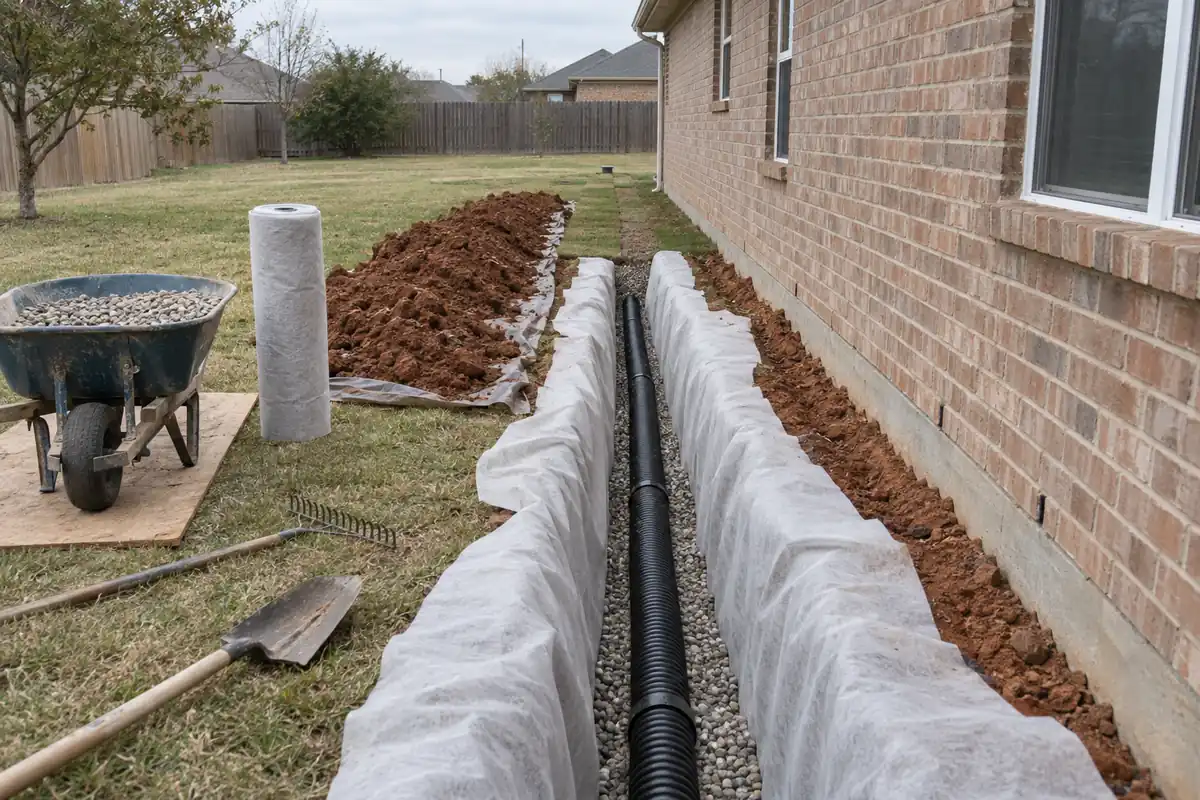
Wichita Falls Foundation Works corrects foundation drainage around slabs and pier and beam houses across Wichita Falls and Wichita County, and the job is narrower than you might expect. Moving water off the clay flattens the swing that drives the ground under a house. It won't lift a slab already dropped, and only the readings say which problem you have.
Booking it costs you nothing. Call (940) 202-0406 and one of us will walk the lot with you.
French drain installation
Perforated pipe sits in a gravel trench wrapped in filter fabric, moving water that already reaches it somewhere legal to leave. French drain installation runs $23 to $50 per linear foot, and a 60 to 80 foot run lands at $1,500 to $4,000. Our design turns on the fall available and the distance to an outfall, more than the pipe.
Drainage correction and grading
Soil gets moved so it falls away from the slab, and we add surface drains, catch basins and downspouts carried past the beds. Regrading alone is $500 to $1,000 for one side, $1,000 to $3,000 all around; a whole job runs $1,100 to $8,000. Drainage correction and grading alongside a pier job saves you a second mobilization.
Root barrier installation
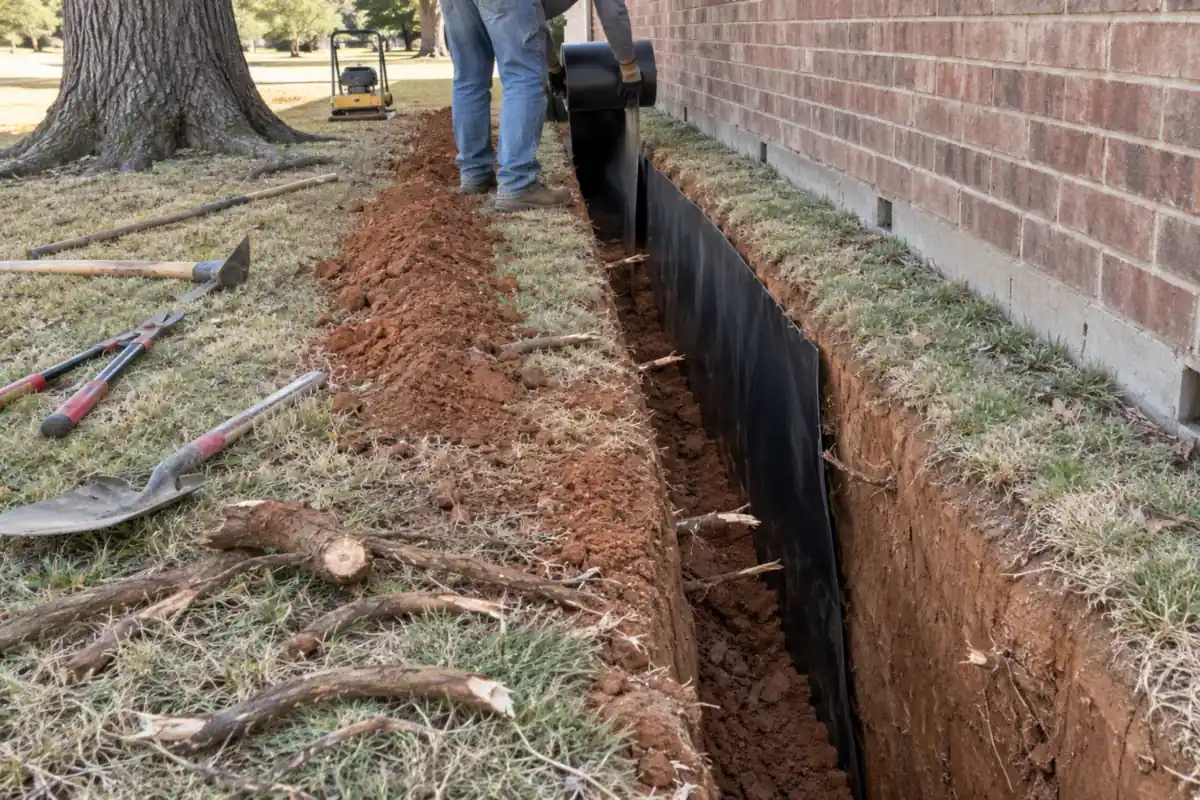
A narrow deep trench goes in between tree and house, a vertical barrier against roots already heading under the beam. Root barrier installation is $65 to $75 per linear foot, most jobs with a minimum around $1,400; a 20 to 40 foot run lands at $1,400 to $3,000. The tree may still want pruning, and our crew leaves that to an arborist.
Soil moisture and foundation maintenance
A perimeter soaker hose or drip line goes on a timer, so the clay at the slab edge stops swinging. Systems run $700 to $5,000. A timer and drip line starts around $700, and a full automatic zone on a controller is $2,500 to $5,000. Here is what soil moisture maintenance involves, and our crew can still do it in a drought, because the ordinance exempts a soaker hose from the daytime ban.
Signs the water around your slab is the problem
Check the water before you blame the house.
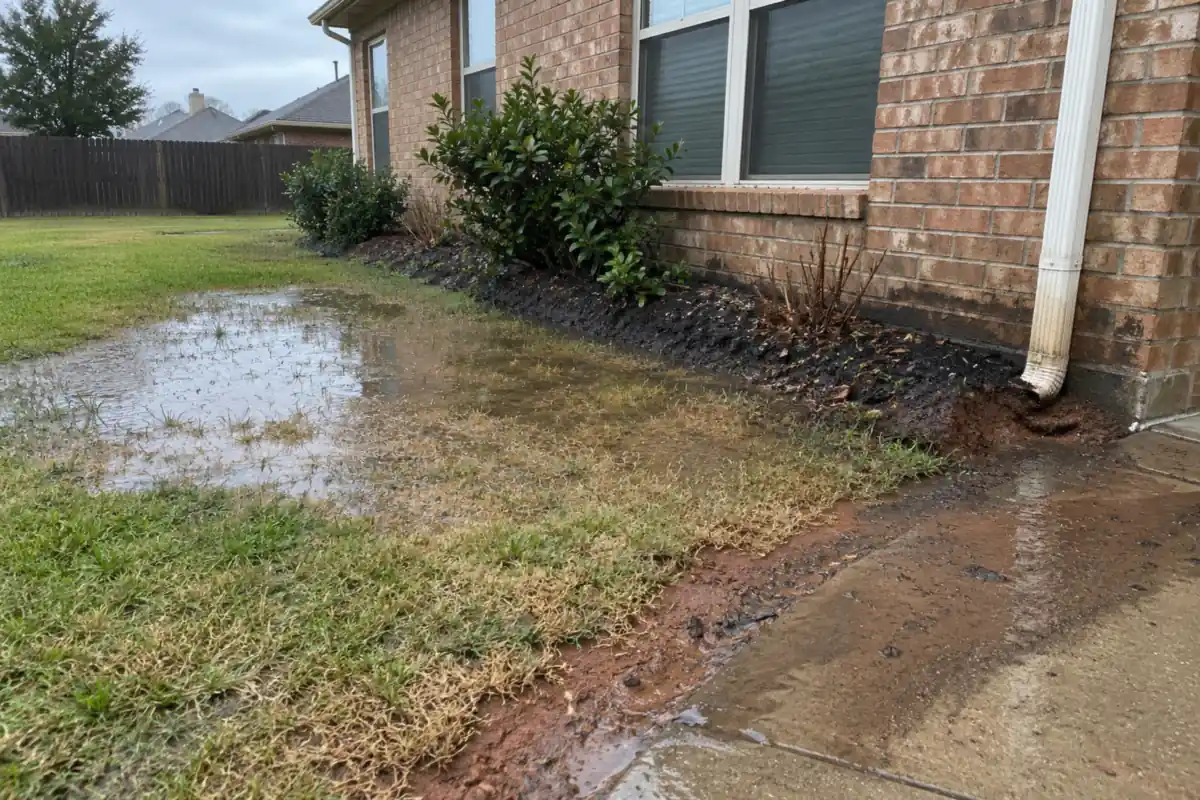
- water standing against the slab for hours after a storm
- a downspout discharging at a corner, not past the beds
- soil or mulch falling back toward the house
- flower beds built up above the brick line, burying the weep holes
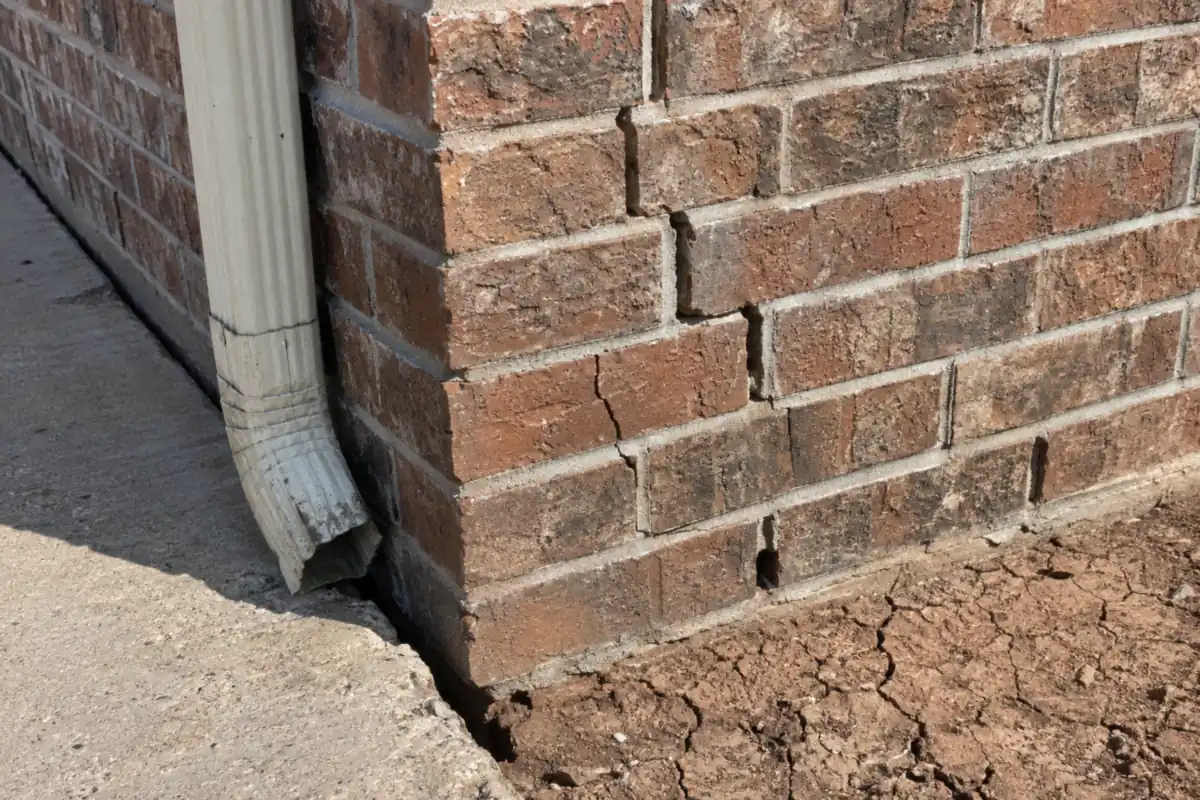
- one corner dropping, a large tree close to it
- a wet, spongy strip along one wall while the rest is dry
But none of it proves the house is out of level. Drainage controls the swing, and only the readings say what it has already done, which is why we measure before we dig.
How a drainage job is measured and built
- The free visit starts with elevation readings inside, then an outside walk over grade at the slab, downspout points, bed height against the brick line and where the lot falls.
- We settle the outfall first, because a drain with nowhere legal to send water is just a trench full of water.
- A written itemized quote comes back run by run, with regrading, surface drains, a French drain and a root barrier as separate lines to accept or drop.
- Then we trench, lay pipe, fabric and gravel, tie in catch basins and extend downspouts.
- We put sod, beds and edging back, and the soaker hose goes on its timer if that line stayed on.
Where readings show the house is already out of level, the pile side of the job comes first.
Why water sits against a slab in Wichita Falls
USDA soil survey maps put the built-up city on gentle ground, with Kamay and Deandale at 0 to 3 percent slopes and the steep ground out on Latom-Urban land at 5 to 20 percent. Flat ground is the trouble here, and it is what our crew grades around.
But these clays don't drink. Kamay has slow permeability, Tillman slow with medium to high runoff, Hollister very slow with high to very high runoff. Rain sheds off them and stops against your brick, and very little of it soaks in. NOAA's rainfall normals peak at 3.81 inches in May, falling to 2.02 in July, and that swing is what our work flattens.
The city knows it. Its water ordinance makes outside spray irrigation between 10:00 a.m. and 7:00 p.m. unlawful year round, and a soaker hose is exempt. At the two most severe drought stages, when every other outdoor use of city water is banned, the ordinance names foundation watering and still allows it: once a week, your Stage 2 day, 7:00 to 11:00 p.m., soaker hoses only.
How much does foundation drainage cost in Wichita Falls?
Per foot and per job are different numbers, and we keep them on separate lines. A French drain is $23 to $50 per linear foot installed. A whole-house correction, a drain run plus surface drains, downspout extensions and grading, is $1,500 to $8,000.
What moves the figure is linear feet and runs, trench depth, whether rock or roots sit in the line, how far to a legal outfall, and how many sides have negative grade. Doing it alongside a pier job saves you a second mobilization.
Want the runs priced separately so you can drop one? Call (940) 202-0406 and tell us which corner holds water.
| Work | Typical range | Notes |
|---|---|---|
| Whole-house drainage correction | $1,500 to $8,000 per job | French drain run plus surface drains, downspout extensions and grading |
| French drain, installed | $23 to $50 per linear foot | A typical 60 to 80 ft run is $1,500 to $4,000 and a 100 ft run $2,280 to $3,560 |
| Drainage correction and grading | $1,100 to $8,000 per job | Regrading alone is about $500 to $1,000 for one side and $1,000 to $3,000 all the way around |
| Root barrier, installed | $65 to $75 per linear foot | Most jobs carry a minimum of about $1,400; a 20 to 40 ft run lands at $1,400 to $3,000 |
| Perimeter soaker hose or drip line on a timer | $700 to $5,000 per system | A timer and drip line run starts around $700; a full automatic zone on a controller runs $2,500 to $5,000 |
Swipe the table sideways to see the notes column.
Published market ranges dated 2026-09-20. We price every job after a free on-site inspection and an elevation survey.
Drainage work across Wichita County
The towns we cover run to Holliday at 14.8 miles on US 277/82, Lakeside City at 10.0 on SH 79, Henrietta at 19.3, and we drive all of them. Lot fall and where the water can legally go change more town to town than the clay does.
What happens when you call
The inspection
A free on-site inspection comes first. We come to the property, look at the work in person, measure, and check the things that change the price before quoting anything.
A written, itemized quote
Every line item goes on paper before any work starts: prep, materials, labor, cleanup and the scheduling window. No verbal numbers.
Warranty terms in the contract
Workmanship and material warranty terms come in writing and go in your contract so you can read them before you sign.
Scheduling you can plan around
You get a start window and a working-day estimate up front, and the crew tells you before anything changes.
Who this is not for
Wichita Falls Foundation Works handles foundation repair and the related work listed on this site. It does not take on unrelated trades; if your job is outside that scope, a specialist in that trade is the right call.
Drainage questions from Wichita Falls homeowners
Will drainage work on its own stop the house moving, or do I still need piles?
Drainage controls the moisture swing that drives the clay, and it won't lift a slab already dropped. Where the elevation survey shows the house out of level, piles come first. Slab repair is what the drainage then protects.
What does a full foundation drainage package cost on a Wichita Falls house?
A whole-house correction runs $1,500 to $8,000. A single French drain run is $1,500 to $4,000. What moves it is how many runs, trench depth, how far to a legal outfall, and how much sod goes back. We price each run on its own line.
Where is the water supposed to go on a flat lot with clay under it?
Out to a legal outfall, meaning a street, an alley or a ditch, and the lot has to give you the fall to reach it. Slow-permeability soils with medium to high runoff, and a built-up city sitting mostly on 0 to 3 percent slopes, are why rain sheds off and stops against the slab.
Do gutters and downspouts really make a difference to a foundation?
A downspout dumping at the corner puts a roof's worth of water into the clay in one spot. Rainfall peaks near 3.8 inches in May, falling to about 2 inches in July, and that is the swing you're flattening. Our estimator checks every downspout at the free visit and extends the ones too close.
French drain, surface drains or regrading. Which one does my house need?
Regrading fixes soil falling the wrong way. Surface drains and extended downspouts catch water where it lands, and a French drain moves subsurface water that already reaches it. The answer turns on where the water is and how much fall the lot gives you. Here is how a French drain is built.
Can a tree be the reason one corner of the house is dropping?
It can. Roots pull moisture out of clay that shrinks under the nearest corner. Pecan, post oak and live oak grow here, and mesquite on Kamay and Tillman soils. Root distance varies by tree, so we check yours before quoting a number of feet.
Water is the part of this trade people skip. Fix the grade, move the downspouts, keep the clay at one moisture.
Call (940) 202-0406 and our quote comes back run by run. If your lot only needs the downspouts moved, that is what we'll say.
Get a written quote
Call (940) 202-0406 or send the form. The next step is a free on-site inspection and a written quote with every line item before any work starts.
Call (940) 202-0406