
French Drain Installation in Wichita Falls, TX: Priced by the Linear Foot, Quoted in Writing
Perforated pipe, gravel and somewhere legal for the water to go, itemized on your written quote before we dig.
- Free on-site inspection
- Priced by the linear foot
- Written itemized quote
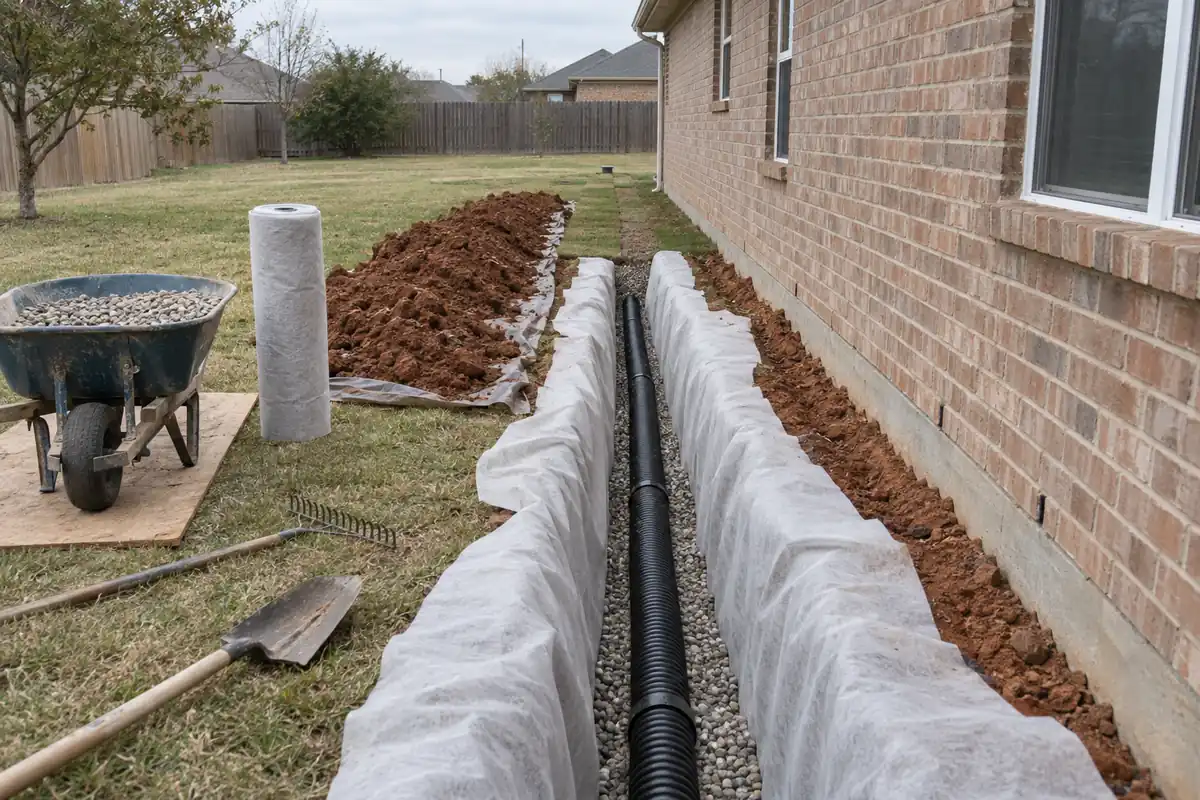
Wichita Falls Foundation Works installs french drain runs around slabs and pier and beam houses in Wichita Falls and Wichita County, priced by the linear foot instead of one number you cannot check. A trench holds a perforated pipe bedded in gravel, and the water it gathers needs somewhere legal to go. The fall on your lot decides whether it works before we buy pipe. Call (940) 202-0406 and our free on-site inspection walks the fall and the outfall first.
That itemized quote breaks pipe, gravel, fabric and restoration into separate lines for you, which is where a cheap bid and an honest one actually differ.
What a french drain installation includes
A french drain is a trench with a perforated pipe bedded in gravel, usually wrapped in non-woven geotextile fabric, and the whole thing runs on gravity. Water finds the pipe before it finds your slab, and the pipe carries it downhill to an outfall, a street, an alley or a ditch. No fall, no function. Foundation drainage work like this is only worth paying for where the outfall is real.
Our written quote itemizes trench depth and width, pipe size, whether the run is wrapped in fabric or fitted with a sock, catch basins tied in, distance to the outfall, and any drive or walk the trench has to cross. We call in 811 locates first, and irrigation lines get marked and avoided.
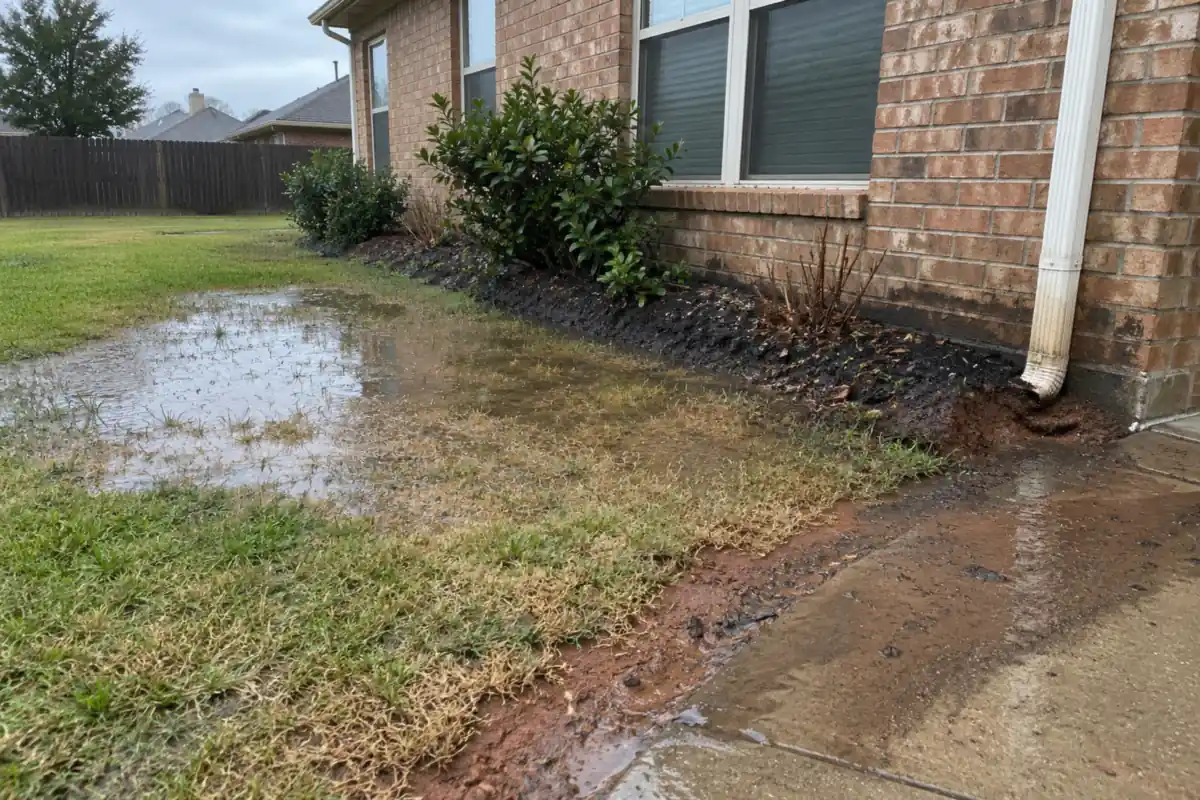
What you get in writing
The on-site inspection costs you nothing, and we walk the trench line and the outfall with you before any number gets written down. Our itemized quote splits trenching, pipe, gravel, fabric and restoration onto separate lines. Warranty terms go in writing too, with the transfer terms spelled out. We quote the scheduling window up front, and we work across Wichita Falls and Wichita County alike.
Signs of standing water Wichita Falls homeowners call about
Standing water rarely announces itself as a foundation problem. It shows up as something else first.
- Doors that stick or will not latch
- Cracked sheetrock at the corners of a door or window frame
- Stair-step cracks climbing the brick mortar
- Nail pops and tape seams showing through the paint
- A gap opening between the baseboard and the floor
- Floors that slope, or a hallway that feels higher in the middle
- Cracked tile with the grout lines pulling apart
- A chimney easing away from the wall
None of that proves your house moved. It proves water is sitting somewhere it should not, and the elevation survey we run tells you the rest of the story.
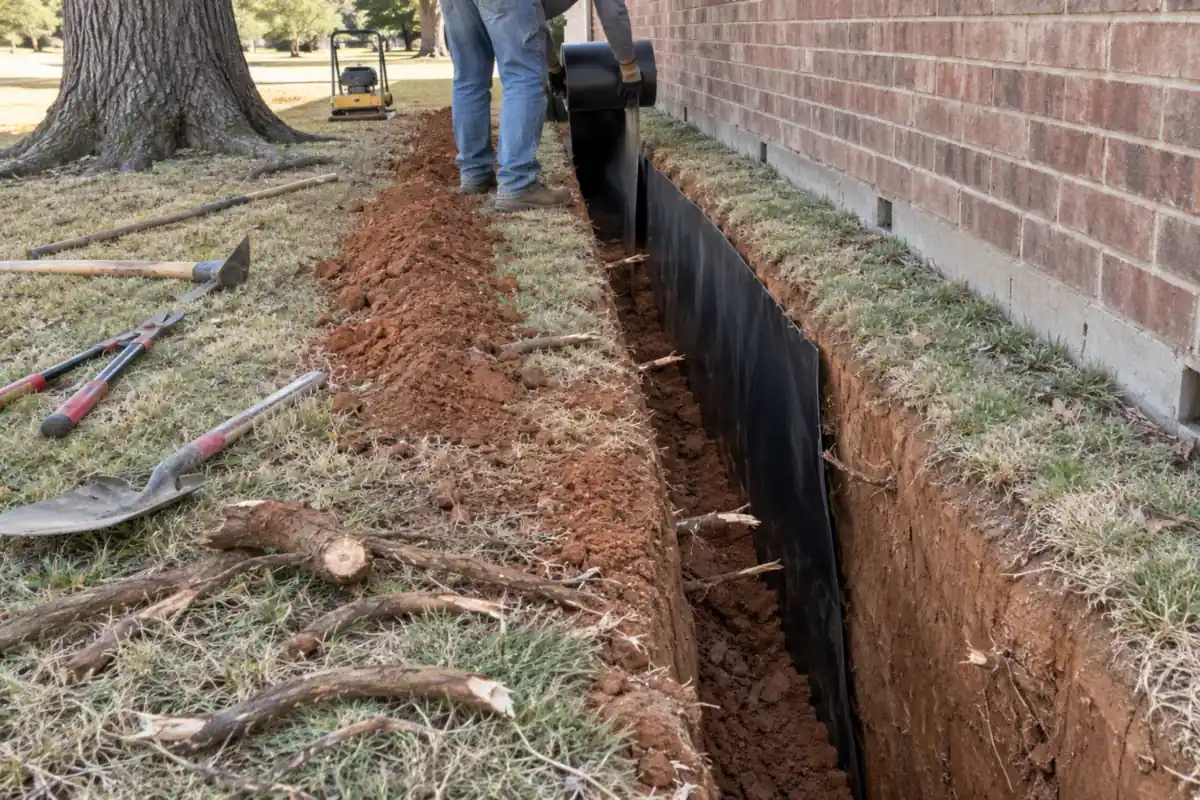
What Wichita Falls homeowners get from Wichita Falls Foundation Works
A trench earns its keep only where water is already moving through the soil. Where it is sitting on top instead, we will tell you that regrading or a surface drain answers the question better, and a flat lot with nowhere to send anything needs a pop-up or a sump rather than a longer run of pipe.
Texas licenses no foundation repair contractor, per TDLR's program list. The City of Wichita Falls licenses and registers contractors and requires a permit before repair or alteration work starts; ask to see both, along with proof of general liability insurance, a written warranty with its transfer terms spelled out, and whether an engineer's report from a Texas professional engineer is included in the price or billed separately.
French drain, surface drains and regrading compared
French drain against regrading. A drain answers water moving through the soil. Regrading answers water sitting on top of it, often cheaper and worth trying first. We cover that surface work under drainage correction and grading.
Catch basins and surface inlets. Where a low spot collects rain from more than one direction, we tie a basin into the same trench and take water off the surface before it reaches the pipe.
Downspouts. Piped into the drain, they add volume the pipe has to carry. Left on splash blocks, they add a second, separate problem. Either way we settle the discharge point with you on the same visit.
One long run against several short ones. A single perimeter run costs less per foot than two or three short trenches, though a tree or an existing root barrier sometimes forces us into the shorter answer.
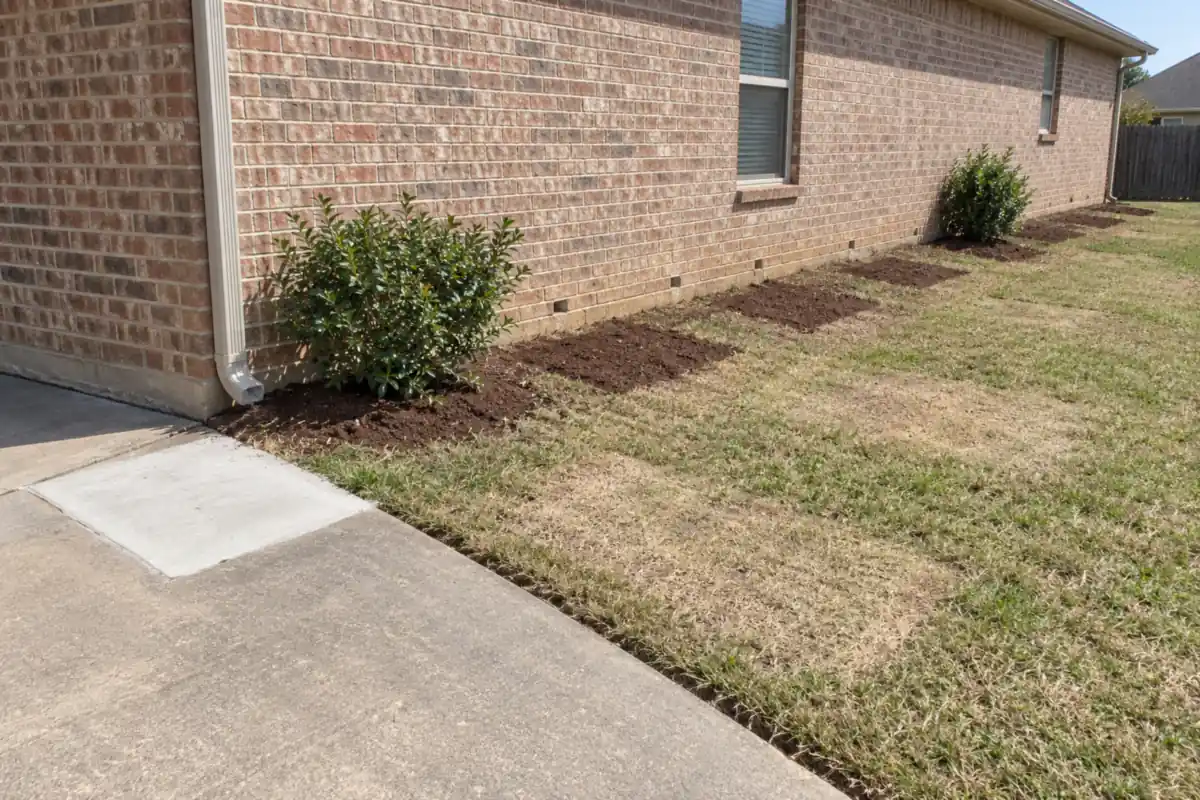
How the job runs, walking the fall to the last square of sod
- The free on-site inspection walks the fall and finds the outfall before a single number gets written down, and you get the scheduling window on the same visit.
- We call in 811 locates, and irrigation lines get marked so nobody cuts one by accident.
- We cut the trench on the line we walked, by trencher where there is room to work and by hand where there is not.
- Pipe goes in bedded on gravel, wrapped or sock-fitted per your quote, with any catch basin or downspout tied in along the way.
- The run carries to the outfall, whether that is a street, an alley, a ditch, or a pop-up and a sump where the lot is flat.
- We backfill the trench and put back sod and beds, and the line stays visible across your yard for a season before the grass closes over it.
Why North Texas clay, water and weather move foundations
USDA lists Kamay as well drained but slow to let water through, carrying low runoff under a one percent slope and medium runoff above it. Hollister runs the other way: very slow permeability, high to very high runoff, same gentle ground. Tillman sits in between, slow with medium to high runoff. Most of the built-up city sits on 0 to 3 percent slopes, with the steep ground pushed out to Latom-Urban land at 5 to 20 percent.
Flat land on slow soil sheds water instead of drinking it, and rain does not help. Wichita Falls averages 27.89 inches a year (NOAA 1991-2020 normals), peaking at 3.81 inches in May and dropping to 2.02 in July before climbing again toward fall. A wet month on flat, slow clay is the setup we build a french drain to answer.
How much does a french drain cost in Wichita Falls?
A french drain runs $23 to $50 per linear foot installed, so a typical 60 to 80 foot run lands at $1,500 to $4,000, and a 100 foot run settles closer to $2,280 to $3,560 once the per-foot price comes down. What moves your number is how many separate runs the yard needs, trench depth, rock or roots in the way, pipe size and whether the run is wrapped in fabric, catch basins tied in, distance to a legal outfall, and any drive, walk or irrigation line crossed.
Call (940) 202-0406 and we write every one of those lines down before you sign anything.
| Work | Typical range | Notes |
|---|---|---|
| French drain, installed | $23 to $50 per linear foot | The line item to compare between two bids |
| Typical 60 to 80 ft run | $1,500 to $4,000 per run | One run along one side of a house |
| 100 ft run | $2,280 to $3,560 per run | Longer runs bring the per-foot figure down |
| Whole-house drainage package | $1,500 to $8,000 per job | French drain plus surface drains, downspouts and grading |
Swipe the table sideways to see the notes column.
Published market ranges dated 2026-09-20. Every job is priced after a free on-site inspection.
French drain work across Wichita County
Service area work runs the same trench, gravel and fabric out to Burkburnett, about 15.4 miles up I-44, and to Iowa Park, roughly 11 to 13 miles out US 287. Holliday sits about 14.8 miles down US 277 and US 82. The pipe is the same in every one of them. What changes is the fall your lot gives us and how far the water has to travel before it reaches somewhere legal to leave.
What happens when you call
The inspection
A free on-site inspection comes first. We come to the property, look at the work in person, measure, and check the things that change the price before quoting anything.
A written, itemized quote
Every line item goes on paper before any work starts: prep, materials, labor, cleanup and the scheduling window. No verbal numbers.
Warranty terms in the contract
Workmanship and material warranty terms come in writing and go in your contract so you can read them before you sign.
Scheduling you can plan around
You get a start window and a working-day estimate up front, and the crew tells you before anything changes.
Who this is not for
Wichita Falls Foundation Works handles foundation repair and the related work listed on this site. It does not take on unrelated trades; if your job is outside that scope, a specialist in that trade is the right call.
French drain questions from Wichita Falls homeowners
What is a French drain and how does it actually work?
A trench holds a perforated pipe bedded in gravel, usually wrapped in filter fabric, and the whole system runs on gravity. Water that reaches the pipe travels downhill to somewhere it can legally leave. Nothing about it needs a pump or a motor.
How deep does the trench have to go?
Deep enough to intercept the water and still keep enough fall to reach the outfall, which is why we set the depth after we walk your lot rather than pulling it off a chart. Trench depth, rock and roots are named price factors, and no local standard depth exists for this market.
What does a French drain cost per foot in Wichita Falls?
$23 to $50 per linear foot installed. A typical 60 to 80 foot run lands at $1,500 to $4,000, and a 100 foot run settles closer to $2,280 to $3,560 once the per-foot price comes down.
Does the trench need gravel and fabric, or is the pipe enough?
Pipe size, gravel and whether the run gets wrapped in fabric are all separate lines on our quote, and they are exactly what separates a cheap bid from an honest one. Compare those lines, not the total at the bottom.
Where should a French drain not go?
Anywhere it cannot legally discharge, or does not have the fall to reach it. The line has to miss irrigation lines and utilities, or bore under a drive and a walk instead of cutting through them, and distance to a street, alley or ditch is a real price factor. A flat lot usually needs a pop-up or a sump.
Where does a French drain let a homeowner down?
It only moves water that actually reaches it. It will not regrade a negative slope, will not stop an under-slab plumbing leak, and will not lift a slab that has already dropped. Drainage correction and grading answers the first of those three.
Could a homeowner dig one themselves?
You can, and the pipe is the cheap part. The trench, the fall and somewhere legal to send the water are the whole job. Call 811 for locates first, and be honest about whether the lot gives you the fall, because a drain with nowhere to go is a buried expense.
Water is cheap to move and expensive to ignore, and a french drain only works where the fall actually gets you somewhere. Get the trench walked before anyone quotes a price off a guess. Call (940) 202-0406 and tell us which corner holds the worst puddle, and we'll walk it with you.
Get a written quote
Call (940) 202-0406 or send the form. The next step is a free on-site inspection and a written quote with every line item before any work starts.
Call (940) 202-0406