
Drainage Correction and Grading in Wichita Falls, TX: Get the Water Off the Slab Before It Moves the House
Grade, downspouts and surface drains, priced line by line after we walk your lot at no charge.
- Free on-site inspection
- Fill, drains and sod itemized
- Written itemized quote
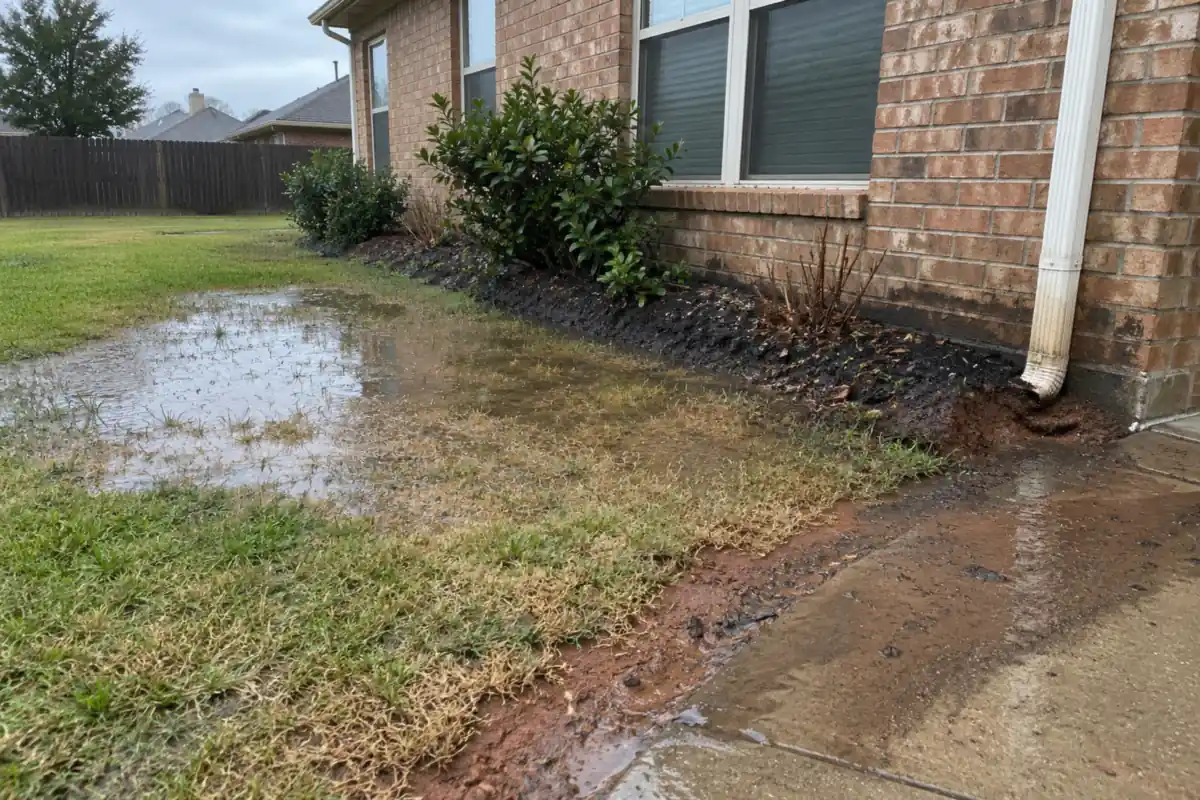
Wichita Falls Foundation Works corrects grade, downspouts and surface drainage around slabs and pier and beam houses in Wichita Falls and Wichita County, so roof and yard water leaves your foundation and stops pooling against the wall. Negative grade is the usual culprit: soil falling back toward the house instead of away from it. Call (940) 202-0406 and we will read the grade at your wall on the free on-site inspection, before anyone writes a number down.
The quote we hand you carries fill dirt, drains and sod back as their own lines, never buried in one total.
What a drainage correction job includes
Where the grade runs backward, rain collects at the wall and has nowhere to leave. The weep holes in the bottom course of mortar tell us where the slab edge actually sits, and they belong above the soil, never buried in it.
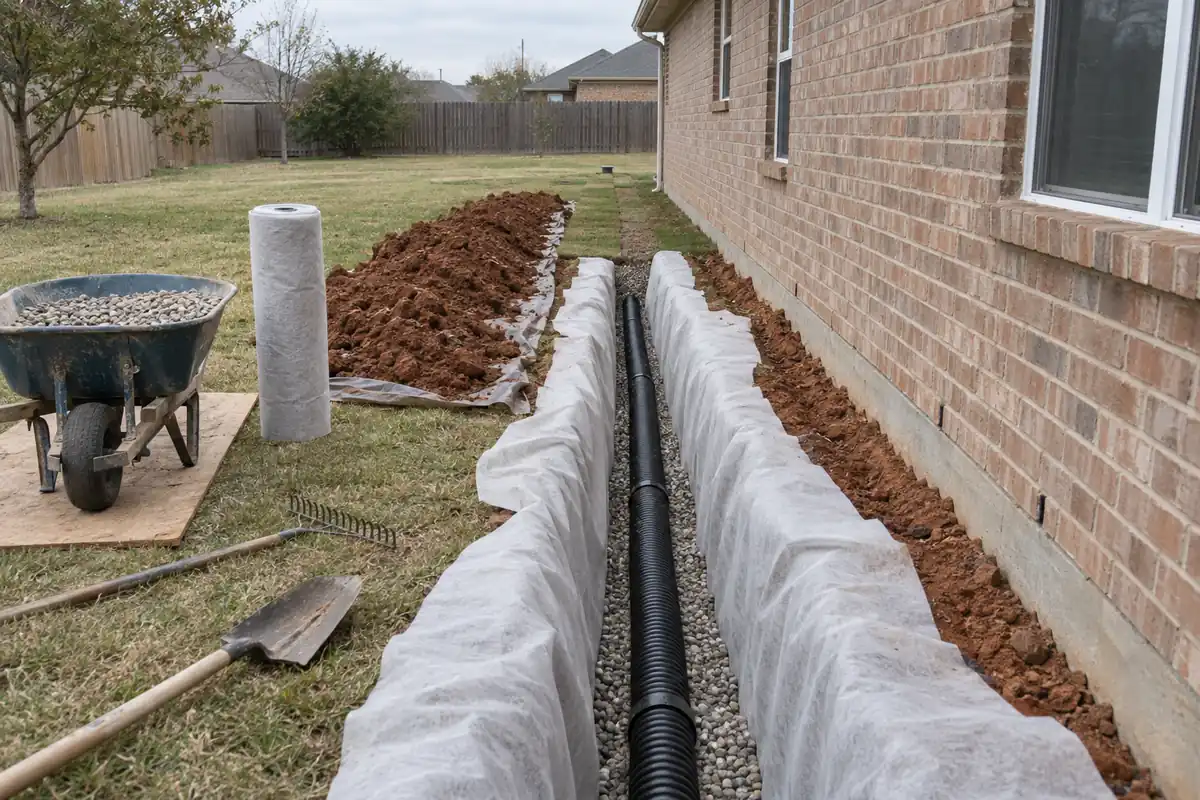
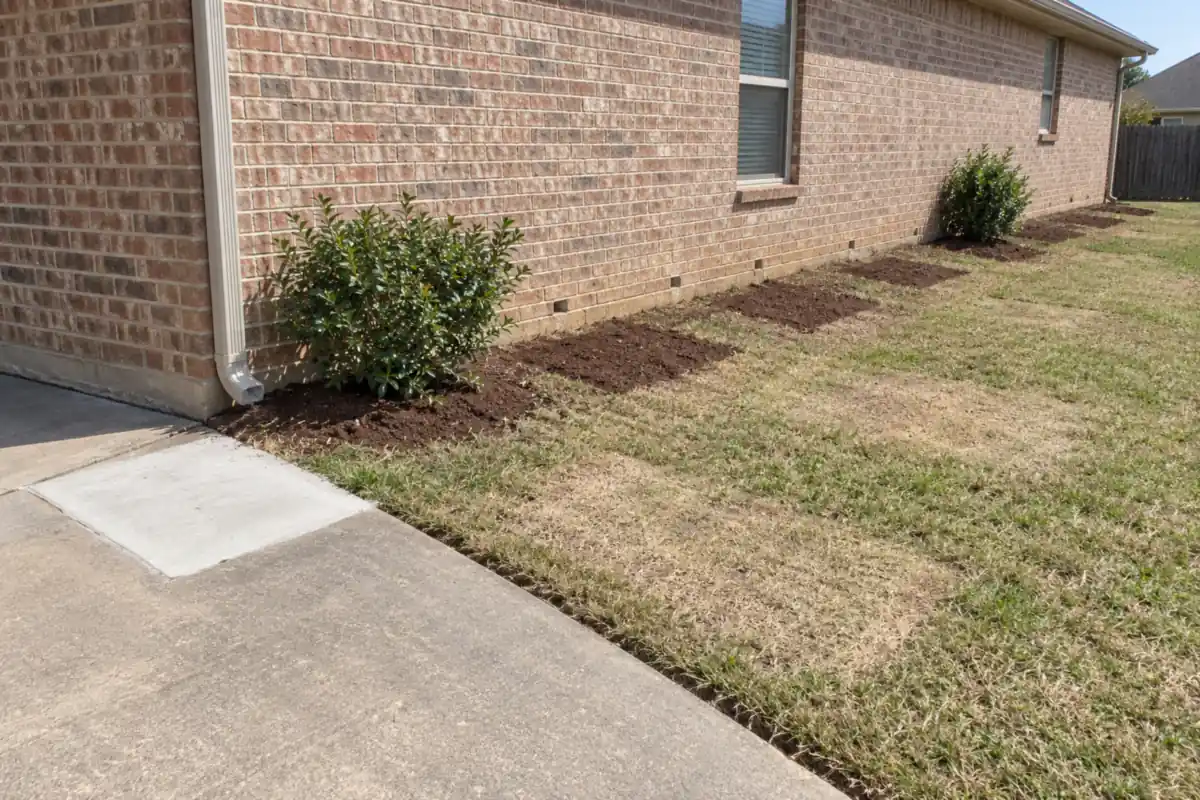
We move soil off the wall, bring fill dirt in, set surface drains and catch basins where water needs collecting, and extend downspouts to somewhere the water can leave. Sod comes up and goes back down, and you see it on the quote as its own line before we start.
What you get in writing
The on-site inspection costs you nothing. Our written itemized quote lists fill dirt, soil removal, drains, downspout work and sod as separate lines. Warranty terms go in writing too, with the transfer terms spelled out. We quote the scheduling window up front, and we work across Wichita Falls and Wichita County alike.
Signs of bad drainage Wichita Falls homeowners call about
Water at the wall shows up inside your house before most people ever think to look outside.
- Doors that stick or will not latch
- Cracked sheetrock at the corners of a door or window frame
- Stair-step cracks climbing the brick mortar
- Nail pops and tape seams showing through the paint
- A gap opening between the baseboard and the floor
- Floors that slope, or a hallway that feels higher in the middle
- Cracked tile with the grout lines pulling apart
- A chimney easing away from the wall
Every one of those can start at a downspout dumping water in the wrong spot, which is the first thing we check outside.
What Wichita Falls homeowners get from Wichita Falls Foundation Works
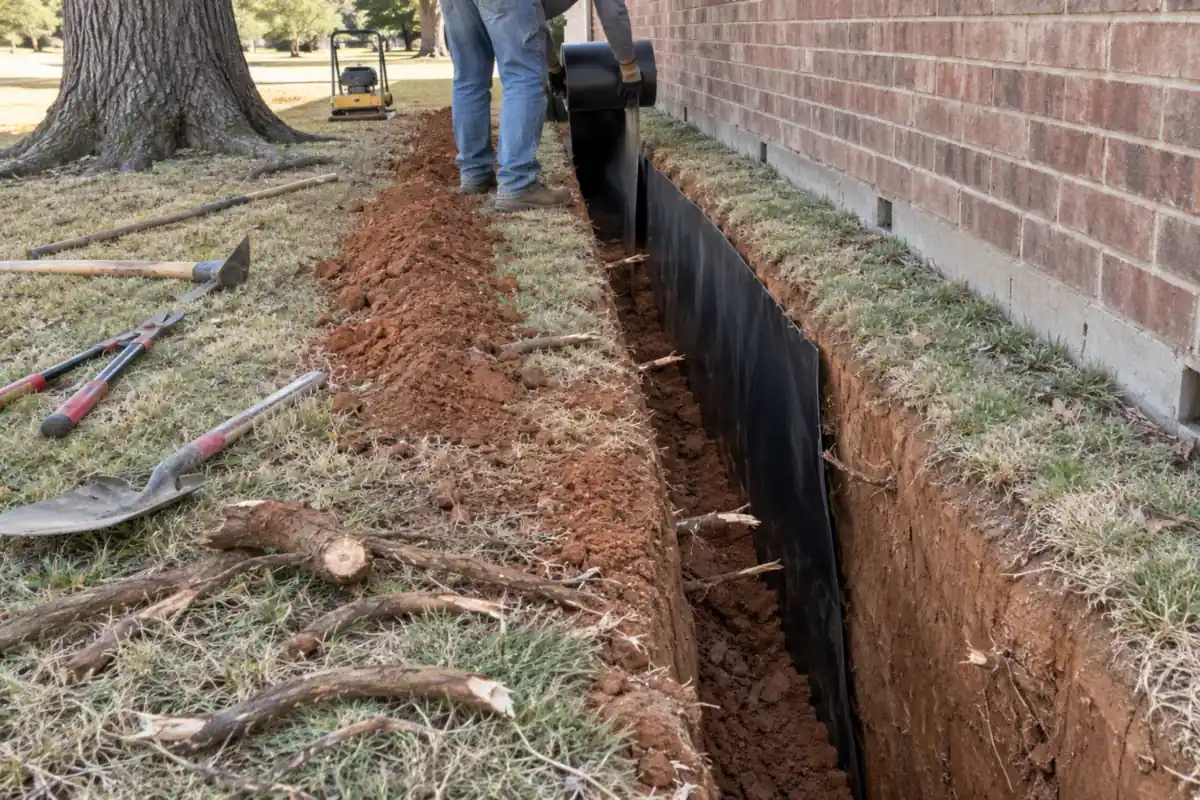
Regrading answers water running across the surface. A french drain answers water already moving through the soil. We work out which one your lot needs by measuring the fall, not by guessing at the curb.
Texas licenses no foundation repair contractor, per TDLR's program list. The City of Wichita Falls licenses and registers contractors and requires a permit before repair or alteration work starts; ask to see both, along with proof of general liability insurance, a written warranty with its transfer terms spelled out, and whether an engineer's report from a Texas professional engineer is included in the price or billed separately.
Regrading, surface drains and a french drain compared
One side against the whole perimeter. Most houses only need the sides where the grade actually runs backward, so we quote those elevations and leave the rest alone.
Surface drains and catch basins. Where your lot gives no fall to push the grade toward, we set a basin at the point the water collects.
Downspout extensions. A piped run or a catch basin beats a splash block on a flat lot every time, because a splash block only moves the puddle a few feet. We will tell you which of the two your downspouts need.
Adding a french drain. Where the water is subsurface rather than sitting on top, we add french drain installation to the same job, and foundation maintenance picks up after both are done.
How the job runs, first walk to sod back down
- The free on-site inspection measures the grade at your wall, checks where the downspouts land, and quotes the scheduling window on the spot.
- Our written itemized quote lists fill dirt in, soil out, drains, downspout work and sod back as separate lines.
- We open the beds and cut soil back off the wall, down below the brick ledge and the weep holes.
- Fill comes in and we build the grade to fall away from the slab.
- Surface drains, catch basins and downspout extensions go in, and we run them to somewhere the water can leave.
- We put sod and beds back, and the line stays visible across your yard for a season.
Why North Texas clay, water and weather move foundations
In USDA soil survey data for Wichita County, Kamay is the soil most often mapped under the developed city, and its clay subsoil carries a plasticity index of 29 and a linear extensibility of 7.5 percent, which NRCS classes as high shrink-swell. It is also well drained but slow to let water through. Hollister runs very slow with high to very high runoff on the same gentle ground.
The built-up city sits mostly on 0 to 3 percent slopes, with the steep ground pushed out to Latom-Urban land at 5 to 20 percent. Flat land on slow, high shrink-swell clay does not absorb rain evenly; it sheds it toward whatever low point is closest, which on most lots is the slab. On NOAA's 1991-2020 climate normals, rainfall peaks at 3.81 inches in May, drops to 2.02 in July, then climbs back to 2.99 in September. That swing between wet and dry is what we build your grade to survive every year.
How much does drainage correction cost in Wichita Falls?
Regrading one side of the house runs $500 to $1,000; going all the way around runs $1,000 to $3,000. A full correction, meaning grade, surface drains and downspout work together, runs $1,100 to $8,000. A french drain added to the same job runs $23 to $50 per linear foot on top.
What moves your number is how much soil has to move and how much fill dirt comes in, how many sides carry negative grade, surface drains and catch basins added, where the downspouts get extended to, whether the lot is flat with nowhere to send water, and sod put back afterward. Call (940) 202-0406 and we will tell you which of those apply to your yard.
| Work | Typical range | Notes |
|---|---|---|
| Whole job: grade, drains and downspouts | $1,100 to $8,000 per job | Grade, surface drains and downspout work together |
| Regrading, one side of the house | $500 to $1,000 per side | Where only one elevation runs back at the slab |
| Regrading, all the way around | $1,000 to $3,000 per house | Full perimeter |
| French drain, added to the same job | $23 to $50 per linear foot | Where the water is subsurface |
Swipe the table sideways to see the notes column.
Published market ranges dated 2026-09-20. Every job is priced after a free on-site inspection.
Drainage correction across Wichita County
Service area coverage reaches Henrietta, about 19.3 miles out US 287 and US 82, Archer City, about 26.1 miles down SH 79, and Electra, about 27.2 miles on US 287. Grade and fall vary lot to lot in every one of those towns the same way they do inside Wichita Falls, so we measure yours before we price anything.
What happens when you call
The inspection
A free on-site inspection comes first. We come to the property, look at the work in person, measure, and check the things that change the price before quoting anything.
A written, itemized quote
Every line item goes on paper before any work starts: prep, materials, labor, cleanup and the scheduling window. No verbal numbers.
Warranty terms in the contract
Workmanship and material warranty terms come in writing and go in your contract so you can read them before you sign.
Scheduling you can plan around
You get a start window and a working-day estimate up front, and the crew tells you before anything changes.
Who this is not for
Wichita Falls Foundation Works handles foundation repair and the related work listed on this site. It does not take on unrelated trades; if your job is outside that scope, a specialist in that trade is the right call.
Drainage questions from Wichita Falls homeowners
What does negative grade mean and how would I spot it?
Soil falling back toward the slab instead of away from it, so water collects at the wall. You see it as mulch and dirt heaped above the brick ledge, puddles standing at the foundation after rain, and a flower bed that never dries. We measure it at the inspection rather than guess at it from the curb.
What does it cost to regrade around the house?
About $500 to $1,000 for one side of the house, $1,000 to $3,000 to go all the way around. A full correction including surface drains and downspout work runs $1,100 to $8,000. Which band you land in depends on how many sides run backward and how much fill we have to bring in.
Can the grade be fixed without tearing up the sod and the beds?
Some soil has to move and some sod comes up. We carry fill dirt in and sod back as their own lines on the quote, so you can see what the restoration costs before we ever open a bed.
Where are the downspouts supposed to end up?
Far enough from the slab that roof water lands where it can leave. On a flat lot that usually means extensions into a catch basin or a piped run rather than a splash block. We check where each one lands before we leave.
Should the drainage be done at the same time as the piles?
Doing both on one mobilization is cheaper than bringing our crew back, and the yard is already open. The piles level the house, and the drainage is what stops the clay swinging back and forth underneath it.
Is drainage work worth it if the house is already level?
Yes, and it is the cheap half of keeping it level. The clay under the city moves with moisture, and drainage is the only part of that you actually control, though nobody can promise it prevents future movement outright. Foundation maintenance picks up the rest.
Water is the cheap half of this trade, and grade is the least expensive part of that half. Move the soil, extend the downspouts, and give the rain somewhere legal to go before it ever reaches the wall. Call (940) 202-0406 and tell us which side of the house holds the water. We'll walk it with you, and the quote comes back one line at a time.
Get a written quote
Call (940) 202-0406 or send the form. The next step is a free on-site inspection and a written quote with every line item before any work starts.
Call (940) 202-0406