
Foundation Maintenance in Wichita Falls, TX: Soil Moisture, Soaker Hoses and the City's Own Watering Rules
A perimeter soaker or drip system on a timer, set to the city ordinance that lets you water a foundation by name.
- Free on-site inspection
- Soaker or drip, quoted separately
- Written itemized quote
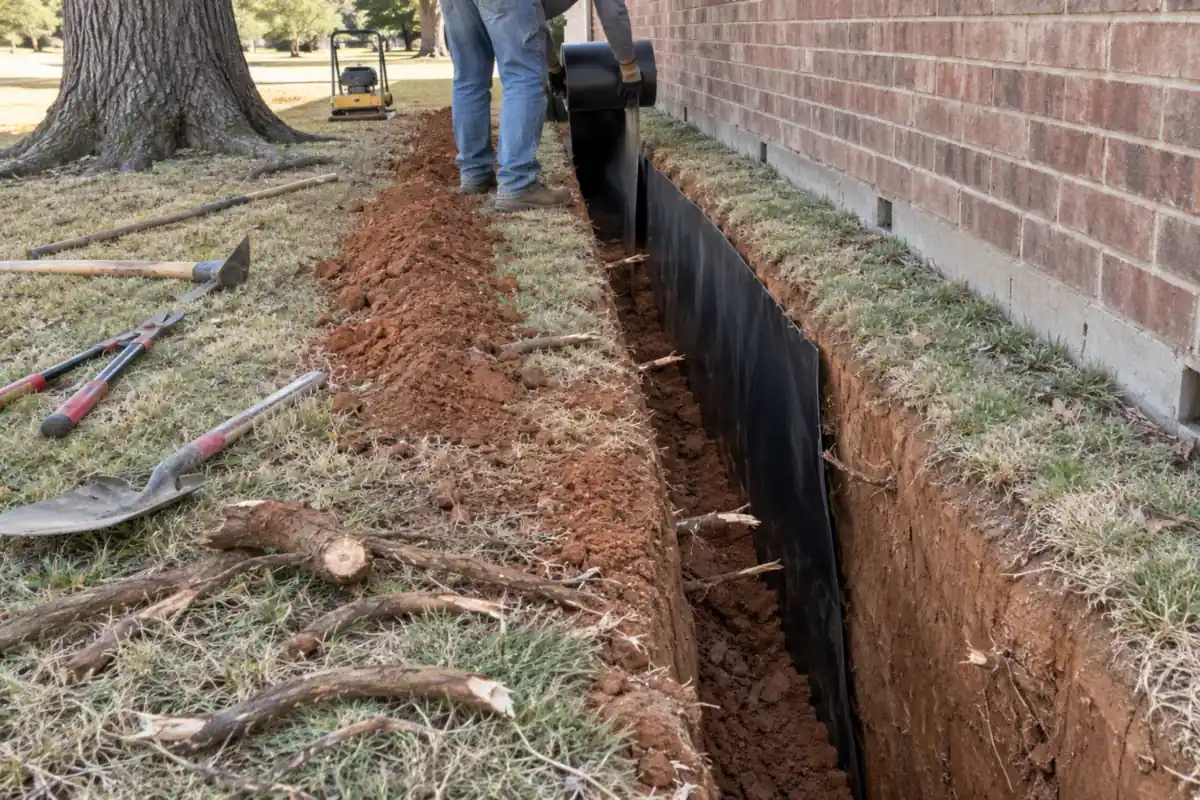
Wichita Falls Foundation Works sets perimeter soaker and drip systems around slabs and pier and beam houses in Wichita Falls and Wichita County, and reads the city's own drought ordinance before telling you how to run one. Even watering slows the swing in the clay; it does not lift a house that has already dropped. Call (940) 202-0406 and we will tell you on the free on-site inspection which of those two situations your house is actually in.
The written quote we hand you says whether the run is a hose-bib timer or a zone plumbed into an existing controller.
What a foundation maintenance system includes
A soaker hose or drip line runs the full perimeter, set back from the slab, on a timer so no side gets more water than another. We build it two ways and they cost differently: a soaker hose on a hose-bib timer, or a drip zone plumbed into an existing irrigation system and controller with a backflow device. Either one crosses beds, walks and drives, and whether we trench the line or simply lay it is its own price factor.
The honest limit matters more than the install. No run time or setback distance is fixed for this market; we set the timer off what we see in your yard, not off a chart. The one schedule that is fixed is the city's own ordinance window.
What you get in writing
The on-site inspection costs you nothing. Our written itemized quote says soaker or drip, how many linear feet, how many zones, and what the timer or controller work costs. Warranty terms go in writing too, with the transfer terms spelled out. We quote the scheduling window up front, across Wichita Falls and Wichita County alike.
Signs the clay is swinging, as Wichita Falls homeowners describe them
Most people blame the house long before they blame a dry August.
- Doors that stick or will not latch
- Cracked sheetrock at the corners of a door or window frame
- Stair-step cracks climbing the brick mortar
- Nail pops and tape seams showing through the paint
- A gap opening between the baseboard and the floor
- Floors that slope, or a hallway that feels higher in the middle
- Cracked tile with the grout lines pulling apart
- A chimney easing away from the wall
Where those show up worse every August and ease off after a wet spell, moisture is doing at least part of the work, and we can put a timer on that part.
What Wichita Falls homeowners get from Wichita Falls Foundation Works
A watering routine is the right next step where the clay is drying and shrinking. We will tell you it is the wrong one where a house is heaving at the center, because pouring water onto a foundation that is already pushing up is not maintenance, it is a guess. We read that advice against the city's own ordinance rather than a rule of thumb from Dallas or Fort Worth.
Drainage and perimeter moisture are the half you can control. The clay and the weather are not, and nobody honest promises otherwise.
Texas licenses no foundation repair contractor, per TDLR's program list. The City of Wichita Falls licenses and registers contractors and requires a permit before repair or alteration work starts; ask to see both, along with proof of general liability insurance, a written warranty with its transfer terms spelled out, and whether an engineer's report from a Texas professional engineer is included in the price or billed separately.
Soaker hose, drip zone and a hose-bib timer compared
A soaker hose on a hose-bib timer. The plainest version, and the one the city's own ordinance names by name at the two most severe drought stages.
A drip zone on an irrigation controller. Plumbed into an existing system with a backflow device, we can run more zones automatically, though it costs more to install.
Doing it yourself. Hose and emitter material is real money saved, and the judgment about run time lands on you instead of on us.
What a drought stage changes. Drainage correction and grading and root barrier installation both compete for the same moisture budget once a stage gets declared, so we plan all three together where a lot needs more than one.
How the install runs, first walk to a timer you can set
- The free on-site inspection walks the perimeter, notes the beds, walks and drives the line has to cross, and quotes the scheduling window on the spot.
- Our written itemized quote names the build, the linear feet, the zones and the timer or controller work, each on its own line.
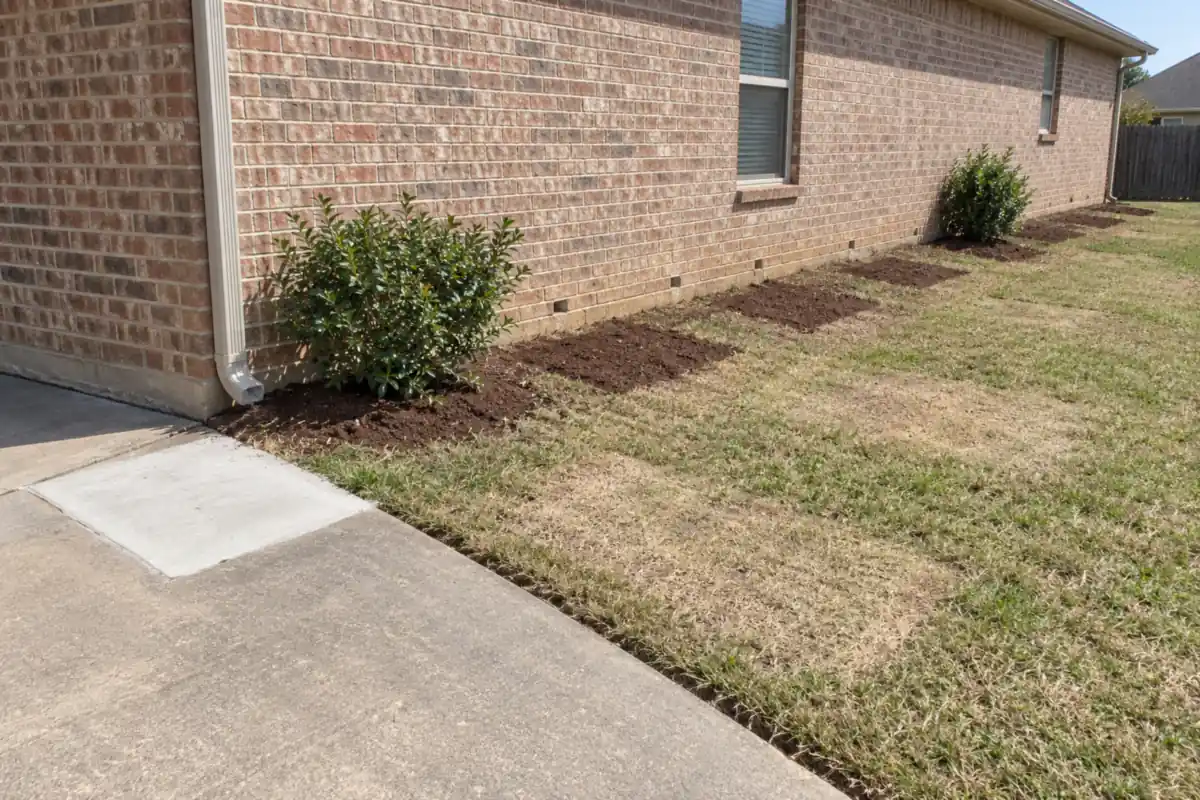
- We lay or trench the line around the perimeter, set back from the slab.
- We balance the emitters or the hose so no side gets more than another.
- We set the timer or the controller zone and show you how to work it.
- The city's own watering rules go home in writing with the paperwork, because the drought stage can change after our crew leaves.
What the City of Wichita Falls drought ordinance says about watering a foundation
The city draws its water from Lake Arrowhead and Lake Kickapoo, and under the city's drought ordinance, the director of public works declares a drought stage on their combined capacity: Stage 1 at 65 percent, Stage 2 at 50, Stage 3 at 40, Stage 4 at 30, Stage 5 at 25. Year round, regardless of the stage, running outside spray irrigation between 10 a.m. and 7 p.m. is unlawful here, and a soaker hose is exempt from that ban every day of the year.
At Stage 4 and Stage 5, when every other outdoor use of city water is banned outright, the ordinance still names the watering of home foundations under a heading of its own, and allows it once a week, between 7 and 11 in the evening, with soaker hoses only. Penalties run $25 for a first offense, up to $500 for a second, and up to $2,000 for every offense after that, with each day counted separately. Kamay, the soil USDA soil surveys map most often under the developed city, has a plasticity index of 29, and NOAA's 1991-2020 normals give Wichita Falls 104.7 days a year at 90 degrees or hotter. That is the swing we use a soaker hose to soften, inside the rules the city actually writes.
How much does a foundation watering system cost in Wichita Falls?
A timer and drip line on the perimeter starts around $700. A full automatic zone tied into an existing irrigation controller runs $2,500 to $5,000, with the whole band for a perimeter soaker or drip system running $700 to $5,000.
What moves your number is linear feet of house perimeter, a soaker hose on a hose-bib timer against a drip zone plumbed into a controller, how many zones and whether a backflow device is needed, trenching or burying the line, and beds, walks and drives crossed. Call (940) 202-0406 and we will say which of those apply to your yard.
| Work | Typical range | Notes |
|---|---|---|
| Perimeter soaker or drip system, installed | $700 to $5,000 per system | Covers a hose-bib timer run through to a full controller zone |
| Timer and drip line on the perimeter | $700 to $700 starting figure | Where a system starts in this market |
| Full automatic zone on an irrigation controller | $2,500 to $5,000 per system | Zones, controller work and a backflow device |
Swipe the table sideways to see the notes column.
Published market ranges dated 2026-09-20. Every job is priced after a free on-site inspection.
Foundation maintenance across Wichita County
Service area coverage reaches Burkburnett, about 15.4 miles up I-44, Lakeside City, about 10.0 miles out SH 79, and Vernon, about 49.7 miles on US 287. The city's watering ordinance governs Wichita Falls itself; a system we install out in the county still runs on the same soaker hose logic.
What happens when you call
The inspection
A free on-site inspection comes first. We come to the property, look at the work in person, measure, and check the things that change the price before quoting anything.
A written, itemized quote
Every line item goes on paper before any work starts: prep, materials, labor, cleanup and the scheduling window. No verbal numbers.
Warranty terms in the contract
Workmanship and material warranty terms come in writing and go in your contract so you can read them before you sign.
Scheduling you can plan around
You get a start window and a working-day estimate up front, and the crew tells you before anything changes.
Who this is not for
Wichita Falls Foundation Works handles foundation repair and the related work listed on this site. It does not take on unrelated trades; if your job is outside that scope, a specialist in that trade is the right call.
Foundation maintenance questions from Wichita Falls homeowners
Is watering the foundation a real thing, or is that an old wives' tale?
It is real enough that the City of Wichita Falls drought ordinance regulates it by name. At Stage 4 and Stage 5, when every other outdoor use of city water is banned, watering home foundations is still expressly allowed, once a week, between 7 and 11 in the evening, with soaker hoses only.
What do the city's watering rules allow right now?
The year-round rules always apply: no spray irrigation between 10 a.m. and 7 p.m., with soaker hoses, drip, a handheld hose with a shut-off nozzle and buckets exempt any day at any time. The stage restrictions on top depend on the combined level of Lakes Arrowhead and Kickapoo, so confirm the current stage with the city before assuming which one applies.
How do I water a foundation without overdoing it?
A soaker hose set back from the slab, run evenly all the way around on a timer, so no one side gets more than another. There is no fixed local run time or setback distance; we set the timer on site. The city's evening soaker-hose window is the one schedule that is fixed by rule.
What does a perimeter soaker or drip system cost?
About $700 for a timer and drip line on the perimeter, up to $2,500 to $5,000 for a full automatic zone plumbed into an irrigation controller. Hose and emitter material alone runs roughly $0.36 to $1.00 a foot if you lay it yourself.
Can watering undo damage that is already there?
No. It slows the swing; it does not lift a house that has already dropped. The elevation survey is what tells you which of those two situations you are in, and it is worth running before you spend money on either.
What are the penalties if I get the watering rules wrong?
$25 for a first offense, up to $500 for a second, and up to $2,000 for each one after that. Every day counts separately, and repeat offenses risk the meter, which is exactly why the soaker-hose exemption is worth knowing.
Nobody in this trade can promise a soaker hose fixes a house that has already moved. What it does is real: it flattens the swing the clay runs on, inside the rules the city actually enforces. Call (940) 202-0406 and tell us what the house does every August. We'll tell you which side of that line it sits on.
Get a written quote
Call (940) 202-0406 or send the form. The next step is a free on-site inspection and a written quote with every line item before any work starts.
Call (940) 202-0406